Key Takeaways:
- Most competitive exam aspirants fail at consistency, not capability. The accountability gap — no external structure, no intervention, no feedback loop — is the #1 reason study plans collapse.
- AI-driven accountability means autonomous agents that monitor your study behavior, track plan adherence, identify early signs of disengagement, and intervene with personalized nudges and schedule adjustments — before you fall off track.
- This is not gamification. Points and badges wear off. Intelligent accountability — streaks, progress intelligence, dynamic rescheduling, and agent-driven check-ins — creates sustained consistency through systems, not willpower.
You made a study plan on Sunday. By Wednesday, it was abandoned. By Friday, guilt replaced motivation. By next Sunday, you made another plan. The cycle repeats.
If this sounds familiar, you’re not alone. Research on habit formation suggests that over 80% of self-directed study plans are abandoned within the first two weeks. Not because the plan was bad. Not because the student lacked intelligence. But because there was no accountability system — no external structure holding them to the plan.
This is the accountability crisis in competitive exam preparation. And AI agents are the solution.
The Accountability Crisis in Exam Preparation
Why do smart, motivated students fail at consistency? Not because they’re lazy. Because the structure of self-directed study is inherently hostile to consistency:
1. No External Structure
In school, attendance is mandatory. In coaching centers, classes have fixed times. But in self-study — which is where the majority of actual preparation happens — there is no external structure. Nobody notices if you skip a day. Nobody adjusts your schedule when you fall behind. Nobody intervenes when your motivation dips.
You are entirely on your own. And human beings are not designed to be self-accountable for months at a stretch without any external input.
2. Decision Fatigue
Every morning, you face the same draining questions: What should I study today? Which subject? For how long? Should I review yesterday’s topic or start something new? Should I take a mock test or do practice questions?
Each decision depletes willpower. By the time you’ve decided what to study, you’ve already spent significant mental energy — energy that should have gone toward actual learning. This is Roy Baumeister’s ego depletion — decision-making capacity is finite, and logistical decisions drain the same resource as intellectual ones.
3. Invisible Progress
When you study for 3 hours, it’s hard to see what you gained. You don’t feel 3% smarter. Your exam score hasn’t visibly changed. The syllabus still looks enormous. Progress in exam preparation is slow, cumulative, and largely invisible on a daily basis — which makes it easy to feel like your effort doesn’t matter.
Without visible progress, motivation erodes. And without motivation, consistency collapses.
4. No Intervention Mechanism
When a student in a coaching center misses three classes, the faculty notices. A teacher might call, a peer might check in. In self-study, nobody notices when you skip a day — or five. There’s no early warning system, no intervention trigger, no recovery mechanism.
By the time you realize you’ve been off track for two weeks, the damage to your schedule is severe — and the guilt makes it even harder to restart.
5. Isolation
Self-study is lonely. Without peers progressing alongside you, without a mentor tracking your journey, without any social dimension to your preparation, studying feels like shouting into a void. This isolation compounds the other factors, creating a negative spiral: skip a day → feel guilty → avoid thinking about it → skip another day → fall further behind → feel more guilty.
What Is AI-Driven Study Accountability?
AI-driven study accountability is an autonomous AI agent that monitors your study behavior, tracks your adherence to the plan, identifies early signs of disengagement, and intervenes with personalized actions — before you fall off track.
It’s the coaching center teacher who notices you’ve been absent — except it never sleeps, never forgets, and knows your study patterns better than any human could.
Critically, this is NOT gamification. Let’s be clear about the difference:
Gamification vs. Intelligent Accountability
| Dimension | Gamification | Intelligent Accountability |
|---|---|---|
| Mechanism | Points, badges, leaderboards | Streaks, progress intelligence, agent intervention |
| Motivation Type | Extrinsic — earn rewards | Intrinsic — see genuine progress, maintain momentum |
| Durability | Wears off in 1-2 weeks | Sustained — adapts and deepens over time |
| Personalization | Same rewards for everyone | Unique interventions based on YOUR behavior patterns |
| Response to Failure | Lose points, drop in leaderboard (punitive) | Reschedule intelligently, offer recovery path (supportive) |
| Behavioral Insight | None — tracks actions, not patterns | Deep — learns your study rhythms, predicts disengagement |
| Example | “You earned 50 XP for completing a quiz!” | “You usually study at 7 PM but haven’t started today. Your streak is at 14 days — here’s a 5-minute session to keep it alive.” |
Most study apps use gamification because it’s easy to implement. Points and badges give a short-term dopamine hit — but research consistently shows the effect fades within 2-3 weeks. After that, the points feel meaningless.
Intelligent accountability works differently. It doesn’t reward you artificially — it makes your real progress visible, maintains momentum through systems, and intervenes intelligently when consistency is at risk.
How AI Agents Build Accountability
The accountability engine in an AI Study Operating System works through five integrated mechanisms:
1. Streak Tracking
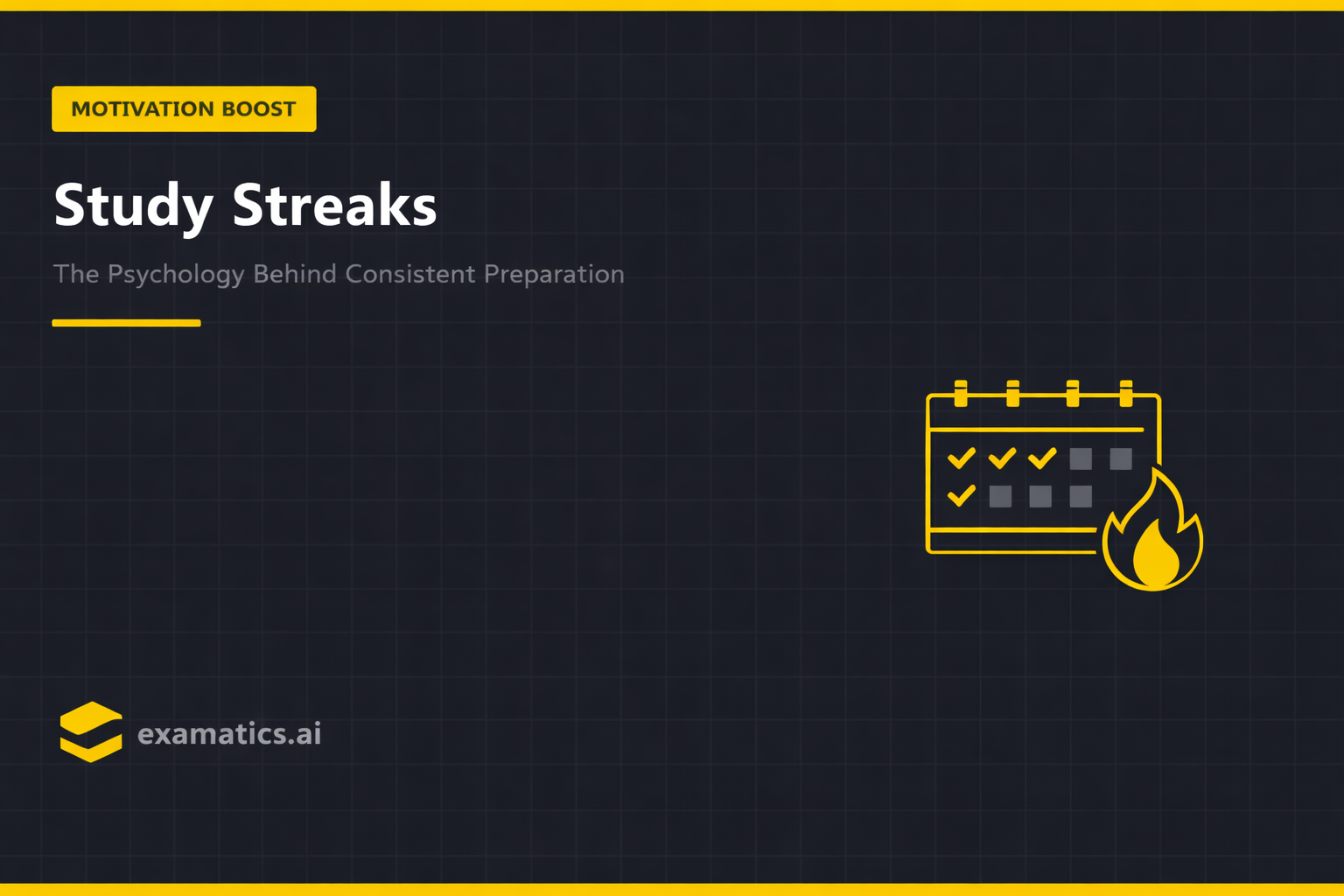
Your consecutive days of study activity become a visible, motivating metric. The psychology behind streaks is powerful:
- Loss aversion — once you have a 15-day streak, the pain of losing it is stronger than the pleasure of extending it. This is one of the most reliable behavioral levers in psychology.
- Identity formation — “I’m someone who studies every day” becomes part of your self-image after 21+ days. Breaking the streak means breaking that identity.
- Social proof — shareable streak cards on Instagram and WhatsApp create external accountability and inspire peers.
The AI agent enhances streaks with smart mechanics:
- Streak-saving grace: If you miss one day after a 20+ day streak, the agent offers a “recovery session” — complete 2 sessions the next day to preserve your streak. This prevents the devastating “I broke my streak, so why bother” effect.
- Milestone celebrations: Days 7, 14, 30, 60, 90, and 180 get special recognition. Each milestone reinforces the identity of consistency.
- Streak history: Even after a break, your longest streak is always visible — a reminder of what you’ve proven you can do.
2. Smart Nudges
Not all notifications are equal. Generic “time to study!” reminders are annoying and quickly disabled. Smart nudges are contextual, personalized, and timed based on your behavior patterns:
- Pattern-based timing: The agent learns when you typically study. If you usually start at 7 PM but haven’t opened the app by 7:15, a gentle nudge arrives: “Your study time usually starts around now. 5-minute session ready.”
- Streak-aware urgency: “You’re at day 21. One session keeps the streak alive.” vs. a generic reminder on day 1.
- Content-specific relevance: “You have a Geography gap flagged from yesterday’s assessment. A 3-minute session to close it is ready.” This makes the nudge feel helpful, not nagging.
- Frequency calibration: The agent adjusts nudge frequency based on your response rate. If you always respond to the first nudge, it doesn’t send three more. If you’ve been ignoring nudges, it escalates gently — once, not repeatedly.
3. Progress Intelligence
Making progress visible is one of the most powerful accountability tools. The AI agent surfaces progress through:
- Daily summary: “Today: 3 sessions completed, 2 gaps closed, 1 new concept mastered. Streak: Day 14.”
- Weekly dashboard: Topics mastered, gaps remaining, time invested, comparison with last week, trajectory toward exam readiness.
- Monthly review: Mastery growth over time, most-improved subjects, persistent weak areas, predicted score improvement.
- Milestone alerts: “You’ve now mastered 100 topics in Indian Polity — you’re in the top 20% of UPSC aspirants on this subject.”
When you can SEE that your daily 15 minutes is producing real, measurable progress, the motivation to continue becomes self-sustaining. The invisible becomes visible.
4. Dynamic Rescheduling
Life happens. You get sick. Family obligations arise. You have a bad day and can’t focus. Traditional study plans break when life happens — and a broken plan creates guilt, which creates avoidance, which creates a longer break.
The AI agent handles disruptions intelligently:
- Missed a day? The agent doesn’t judge. It doesn’t send a guilt-laden notification. It reschedules the missed content intelligently — spreading it across the next few days without overwhelming your schedule.
- Missed a week? The agent reprioritizes: it identifies the must-master topics among the missed content, schedules those first, and deprioritizes lower-weight topics. Your preparation integrity is preserved.
- Study capacity changed? If you tell the agent you can only study 1 hour per day instead of 3 (new job, family emergency, health issue), it rebuilds the entire plan around the new constraint — protecting high-priority topics.
The key principle: the plan serves you, not the other way around. When the plan breaks, the system adapts. You never start from zero.
5. Peer Benchmarking
Knowing where you stand relative to peers provides calibration, not competition:
- “Your mastery in Economics is in the top 30% of UPSC aspirants — strong, but there’s room to improve.”
- “Your Physics gap closure rate is slower than average — the agent has scheduled additional focused sessions this week.”
- “Students who maintained 30-day streaks scored 23% higher on mock tests than those with broken streaks.”
This isn’t a leaderboard designed to shame. It’s intelligent benchmarking that helps you understand your competitive position and make informed decisions about where to invest your time.
The Psychology Behind Streaks and Nudges
The accountability mechanisms in an AI Study OS aren’t arbitrary — they’re grounded in behavioral psychology:
Habit Formation Science
Charles Duhigg’s habit loop (cue → routine → reward) maps perfectly onto the AI accountability system:
- Cue: Smart nudge arrives at your usual study time
- Routine: Complete a micro-session
- Reward: Streak extends, progress visualization updates, mastery grows
Research suggests it takes 21-66 days to form a habit — the AI agent ensures you have the support to get through this critical formation period.
Loss Aversion
Daniel Kahneman’s prospect theory shows that losses feel roughly twice as powerful as equivalent gains. A 30-day streak that’s at risk of breaking creates more motivation than the prospect of starting a new streak. The accountability engine leverages this — your streak becomes an asset you protect.
Self-Efficacy Theory
Albert Bandura’s research shows that belief in your own capability is one of the strongest predictors of persistence. When the AI agent shows you visible progress — “You’ve mastered 50 more topics this month than last month” — it builds self-efficacy. You believe you can succeed because you can see yourself succeeding.
Implementation Intentions
Psychologist Peter Gollwitzer’s research on implementation intentions — pre-deciding WHEN and WHERE you’ll perform a behavior — dramatically increases follow-through. The AI agent automates this: your study sessions are pre-scheduled, your micro-lessons are pre-selected, and your nudges arrive at pre-determined optimal times. You don’t need to decide IF you’ll study or WHAT you’ll study — the intention is already implemented.
Accountability in the AI Study Operating System
In Examatics.ai, accountability isn’t a separate feature bolted onto a study app. It’s the connective tissue of the entire system:
- The agent that plans your study also tracks your adherence to that plan
- The agent that delivers micro-lessons also monitors your engagement and responds to drops
- The agent that runs assessments also flags when performance dips and schedules intervention
- The agent that tracks your streak also adjusts difficulty and volume based on your consistency
Everything is connected. When you miss two sessions, the planning agent knows. When your assessment performance drops in a subject you’ve been skipping, the accountability agent connects the dots. When your streak is at risk, the nudge arrives with a specific session — not a generic reminder but a targeted 3-minute opportunity to maintain momentum.
This integration is what separates intelligent accountability from surface-level gamification. It’s not points for actions — it’s a system that understands your study behavior holistically and acts to keep you on track.
Building Your Accountability System
Here’s a practical framework for establishing AI-driven accountability:
Step 1: Set a Daily Minimum
Even 10 minutes counts. The goal isn’t hours per day — it’s days without a break. Tell the AI agent your minimum daily commitment, and it will build sessions that fit within it. On your worst day, 10 minutes keeps the streak alive and the habit intact.
Step 2: Enable Agent Nudges
Allow the AI agent to send contextual nudges. Not all notifications — just study nudges at your optimal times. These aren’t annoying reminders. They’re intelligent, timed prompts that arrive when you’re most likely to act — and most likely to benefit.
Step 3: Make Your Streak Visible
Share your streak on social media — Instagram stories, WhatsApp status. This creates external accountability. When your friends know you’re on a 30-day streak, breaking it has social cost. This isn’t vanity — it’s behavioral science applied to exam preparation.
Step 4: Review Weekly Progress
Every Sunday, spend 5 minutes reviewing your weekly progress dashboard. See what you mastered, where gaps remain, how your trajectory looks. This weekly ritual reinforces the connection between daily effort and long-term progress.
Step 5: Let the Agent Handle Rescheduling
When you miss a session, resist the urge to manually rebuild your plan. Let the AI agent handle it. It’s faster, smarter, and guilt-free. The plan adapts. You continue. No drama.
Stop Relying on Willpower
Willpower is a finite resource. It depletes with every decision, every stressful moment, every temptation. Relying on willpower for 12-18 months of competitive exam preparation is like running a marathon on a single glass of water.
An AI accountability agent is an infinite willpower supplement. It doesn’t get tired. It doesn’t forget. It doesn’t judge. It watches, learns, nudges, adapts, and keeps you on track — systematically, patiently, and personally.
Stop relying on willpower. Let an AI agent hold you accountable.
Examatics.ai delivers intelligent accountability integrated with study planning, microlearning, and adaptive assessment — a complete AI Study Operating System where consistency isn’t hoped for. It’s engineered.
Your study plan shouldn’t depend on willpower. Let an AI agent keep you on track →