Key Takeaways:
- Adaptive assessment adjusts in real-time to your ability level — if you answer correctly, the next question is harder; if you struggle, it probes the specific gap. Every question is strategically chosen by an AI agent.
- Unlike fixed mock tests that give everyone the same questions, adaptive assessment maps your individual knowledge state and evolves with you over time.
- In an AI Study Operating System, assessment isn’t a separate activity — it feeds directly into your study plan. Every gap identified triggers targeted micro-lessons automatically.
Traditional tests tell you what you got wrong. Adaptive assessments figure out why you got it wrong — and make sure you never get it wrong again.
This is the fundamental difference between assessment as judgment and assessment as growth. For competitive exam preparation — where the margin between selection and rejection is often 2-5 marks — this difference is transformative.
This guide explains what adaptive assessment is, how it works under the hood, why it matters for competitive exams, and how it integrates with an AI Study Operating System to create a continuous learning loop.
What Is Adaptive Assessment?
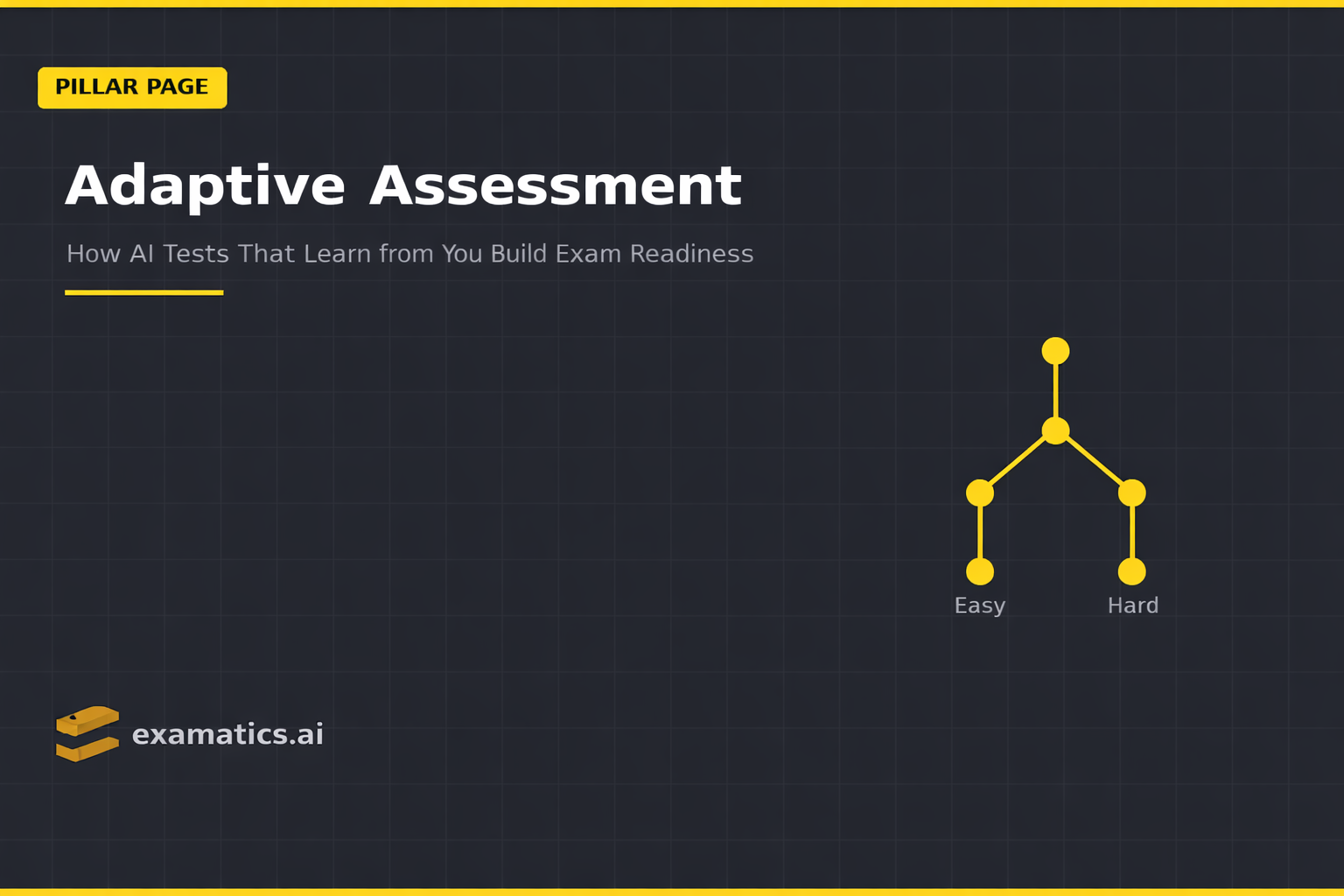
Adaptive assessment is testing that adjusts in real-time to the test-taker’s ability level. Every question is selected by an AI algorithm based on your performance on previous questions — creating a test experience that is unique to you.
Here’s the core mechanic:
- You start with a question of medium difficulty.
- Answer correctly → the next question is harder, probing the edge of your knowledge.
- Answer incorrectly → the next question targets the specific sub-concept you’re missing, identifying the root of the gap.
- After each answer, the AI updates its model of your knowledge state — what you know, what you don’t, and how confident it is in that assessment.
- The test continues until the AI has a high-confidence map of your abilities across the tested domain.
The result isn’t just a score. It’s a diagnostic map — showing precisely which sub-topics you’ve mastered, which you’re developing, and which need focused work.
This is fundamentally different from a fixed test, where everyone gets the same 100 questions regardless of their level. In a fixed test, a strong student wastes time on easy questions that tell the system nothing new, while a struggling student faces questions too hard to learn from.
Adaptive assessment respects your time and targets your growing edge — the zone where learning happens fastest.
How Adaptive Assessment Differs from Fixed Tests
| Dimension | Fixed Tests | Adaptive Assessment |
|---|---|---|
| Question Selection | Predetermined, same for everyone | AI-selected based on your responses |
| Difficulty | Fixed — designed for the “average” student | Dynamic — adjusts after every answer |
| Personalization | None | Deep — every test is unique to you |
| Diagnostic Depth | Surface — “you got 65%” | Precise — “you’re weak in electrochemistry, specifically Nernst equation applications at non-standard conditions” |
| Feedback Timing | After the entire test | After every question (in practice mode) |
| Follow-Up | None — you review answers, then what? | Agent-driven — gaps trigger targeted micro-lessons |
| Motivation | Can demoralize (too hard) or bore (too easy) | Optimal challenge — always at your growing edge |
| Repeat Value | Diminishing — you’ve seen the questions | Consistently high — new questions calibrated to your evolving level |
| Time Efficiency | 30-50% of questions provide no diagnostic value | Every question maximizes information gain |
| Knowledge Mapping | Snapshot — one point in time | Continuous — builds a picture over every session |
For a detailed side-by-side analysis, read our comparison of adaptive tests vs. fixed mock tests.
The Engine Behind Adaptive Assessment
Understanding how adaptive assessment works — even at a simplified level — helps you trust the system and use it effectively. Here’s what happens behind the scenes:
1. Knowledge State Estimation
The AI maintains a model of what you know and don’t know across every topic in your exam syllabus. This model starts broad (after your diagnostic test) and becomes increasingly precise with every question you answer.
Think of it as a heat map: topics you’ve mastered are green, topics you’re developing are yellow, and topics with gaps are red. After every assessment session, the map updates — sometimes a yellow topic turns green (you’ve mastered it), and sometimes a topic you thought was green reveals a hidden gap (a specific sub-concept you missed).
2. Question Selection Algorithm
This is the core intelligence. The algorithm doesn’t pick the “next” question from a bank — it picks the question that will give maximum information about your ability.
If the AI is 90% confident you know Organic Chemistry basics but only 40% confident about reaction mechanisms, it selects a reaction mechanism question — because that’s where the information gain is highest. Testing you on something it already knows you know is a waste of both your time and the system’s diagnostic capacity.
This principle — maximum information gain per question — is what makes adaptive assessment dramatically more efficient than fixed tests.
3. Real-Time Calibration
After every single answer, the AI recalculates:
- Your estimated ability level in the tested domain
- The confidence interval around that estimate
- Which sub-topics need more probing
- What difficulty level maximizes learning for the next question
This happens in milliseconds. The test feels seamless — you simply see the next question. But behind the scenes, the AI is continuously recalibrating to match your exact level.
4. Gap Mapping
The output of an adaptive assessment isn’t just a score — it’s a gap map. This map identifies:
- Mastered sub-topics — concepts where your performance is consistently strong across multiple question types and difficulty levels
- Developing sub-topics — concepts where you’re sometimes right but inconsistent, suggesting partial understanding
- Gap sub-topics — concepts where you consistently struggle, with specific identification of WHERE understanding breaks down
For example, a fixed test might tell you: “You scored 55% in Physics.” An adaptive assessment tells you: “You’ve mastered Kinematics and Work-Energy theorems. You’re developing in Electrostatics (strong on Coulomb’s Law, weak on electric potential due to continuous charge distributions). You have gaps in Rotational Motion, specifically moment of inertia for composite bodies and rolling without slipping.”
That level of specificity turns assessment from a judgment into a roadmap.
5. Agent-Driven Follow-Up
In a standalone test app, the gap map is information you need to act on manually. You review your weak areas, find relevant study material, plan when to revisit them, and hope you remember to do it.
In an AI Study Operating System, the follow-up is automatic:
- Gap identified: “Moment of inertia for composite bodies”
- AI planning agent adds targeted micro-lessons on this specific sub-topic to your schedule
- Content agent delivers 2-3 focused micro-sessions over the next week
- Assessment agent retests the concept 5-7 days later to verify the gap is closed
- If closed → move on. If persistent → escalate with deeper content and more practice.
This test → teach → retest loop runs continuously, closing gaps faster than any manual process.
Why Adaptive Assessment Matters for Competitive Exams
In competitive exams, the difference between selection and rejection is razor-thin:
- UPSC Prelims cutoff varies by 5-10 marks annually — often 2-3 questions decide your fate
- JEE Advanced ranks are separated by fractions of a mark at competitive cutoffs
- NEET seat allocation at top medical colleges is determined by single-digit mark differences
- CAT percentile differences between IIM calls and rejections can be 0.5-1 percentile
At this level, generic preparation isn’t enough. You need to know EXACTLY where your gaps are and close them with surgical precision. That’s what adaptive assessment delivers — and what fixed mock tests, by design, cannot.
Fixed tests tell you your rank among test-takers. Adaptive tests tell you precisely which 5 sub-topics, if mastered, would move you from the rejection zone to the selection zone. That’s the difference between information and intelligence.
Adaptive Assessment in the AI Study Operating System
In Examatics.ai, adaptive assessment isn’t a standalone feature — it’s deeply integrated into the Study OS:
Assessment feeds planning. Every adaptive test updates your knowledge state model, which the planning agent uses to rebalance your study schedule. If an assessment reveals unexpected weakness in a topic you thought you’d covered, the planning agent automatically allocates more time to it.
Assessment triggers content. When a gap is identified, the content agent immediately queues relevant micro-lessons. You don’t need to search for study material — it arrives, targeted to the exact sub-concept the assessment flagged.
Assessment drives accountability. The accountability agent uses assessment data to calibrate nudges. If your assessment shows declining performance in a subject you’ve been skipping, the nudge becomes more insistent. If performance is improving, the agent celebrates the progress and maintains momentum.
Assessment informs benchmarking. Your adaptive test performance is compared against anonymized peer data — not on raw scores (which differ because tests are personalized) but on mastery levels per topic. You can see that you’re in the top 15% for Organic Chemistry but bottom 30% for Mechanics — actionable competitive intelligence.
This integration is why assessment in an AI Study OS is fundamentally different from assessment in a standalone test app. It’s not a separate activity — it’s the diagnostic heartbeat of the entire system.
Comparative Performance Reports: Know Where You Stand
Beyond individual assessment, Examatics.ai generates comparative performance reports that answer critical strategic questions:
| Report Element | What It Shows | Strategic Value |
|---|---|---|
| Topic Mastery Heatmap | Your mastery level across all syllabus topics | Visual identification of strongest and weakest areas |
| Gap Priority Ranking | Weak topics ranked by exam weight × gap severity | Tells you where to invest time for maximum mark gain |
| Peer Benchmark | Your mastery vs. other aspirants, topic by topic | Identifies where you’re below average and need to catch up |
| Progress Trajectory | Mastery trend over weeks and months | Shows whether you’re on track or plateauing |
| Predicted Score Range | Estimated exam score based on current mastery | Gives you a reality check on readiness |
| Time-to-Mastery Estimate | Estimated hours needed to close remaining gaps | Helps plan the final preparation phase |
These reports aren’t vanity metrics. They’re decision-support tools that help you and your AI agent optimize the remaining preparation time for maximum impact.
From Assessment to Mastery
Assessment in the traditional system is an endpoint — you take a test, get a grade, and move on. Assessment in an AI Study Operating System is a continuous feedback mechanism that drives every other component of your preparation.
Every question you answer makes the AI smarter about your knowledge state. Every gap it identifies triggers a learning response. Every re-assessment verifies whether the gap is closed. The cycle — test, teach, retest, advance — runs continuously, automatically, and personally.
Every question you answer makes the AI smarter about making you smarter.
This is assessment as learning. This is the AI Study OS difference.
Examatics.ai delivers adaptive assessment integrated with study planning, microlearning, and accountability — creating a closed-loop learning engine that evolves with every interaction.
Your tests should teach you, not just grade you. Experience adaptive assessment on Examatics.ai →